The Personal Project can feel overwhelming.
There are deadlines to manage, criteria to understand, evidence to collect, and a report to write.
Many students lose marks not because they lack ability. They lose marks because they are unsure what the IB is really looking for.
✔ Understand the criteria
✔ Plan with confidence
✔ Build stronger evidence
✔ Write a more focused report
✔ Submit with clarity
This system is organised into nine structured sections that guide you from your first idea to your final submission.
You do not need to know everything today.
You only need to focus on the next step.
One clear path. One structured system. One confident submission.
Most students do not lose marks because they lack ability. They lose marks because they are unclear about what the IB is really rewarding.
In the next lesson, you'll learn how successful students use this system to move from understanding the criteria to building a stronger Personal Project.
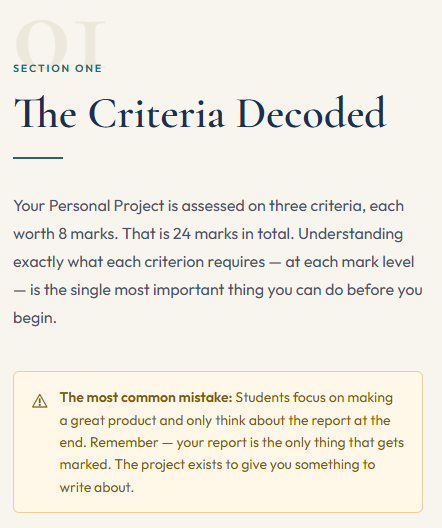
Your Personal Project is assessed using three criteria worth 8 marks each.
Understanding what examiners are looking for before you begin your project is one of the most effective ways to improve your final result.
In this section, you will learn:
✓ What Criterion A (Planning) actually assesses
✓ How Criterion B (Applying Skills) is rewarded
✓ What strong reflection looks like in Criterion C
✓ How command terms affect your markband
✓ What distinguishes a 7–8 response from a 3–4 response
You will be able to:
Explain all three criteria in student-friendly language.
Recognise what examiners reward.
Understand the command term ladder.
Identify the evidence needed for high marks.
The Personal Project is not about creating the biggest or most impressive product. It is about demonstrating learning, skills, planning, and reflection through evidence.
Continue to:
Learn the most common mistakes students make in the Personal Project and discover what examiners actually reward, so you can focus your time and effort where it matters most.
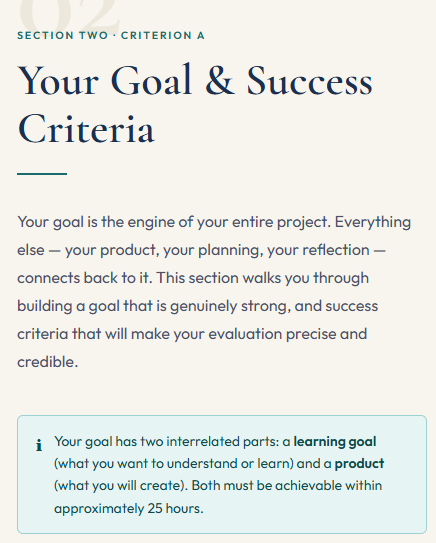
Your goal and success criteria form the foundation of your entire Personal Project.
A strong project begins with a meaningful learning goal, a realistic product, and detailed success criteria that clearly define what success looks like.
Everything you do later—your planning, ATL skills, reflection, and evaluation—connects back to the decisions you make in this section.
✓ How to identify a genuine personal interest
✓ How to write a strong learning goal
✓ How to choose an appropriate product
✓ How to avoid overly ambitious projects
✓ How to create detailed success criteria
✓ How to evaluate your work effectively later in Criterion C
You will have:
A clear learning goal
A realistic product
4–6 detailed success criteria
A strong foundation for Criterion A
Your learning goal is the engine of your Personal Project. Everything else connects back to it.
Continue to:
Lesson 1 – The Foundation of Your Project
Learn how your personal interest, learning goal, product, and success criteria work together to create a strong Personal Project.