Bonus V1.0: Manage Your Workload
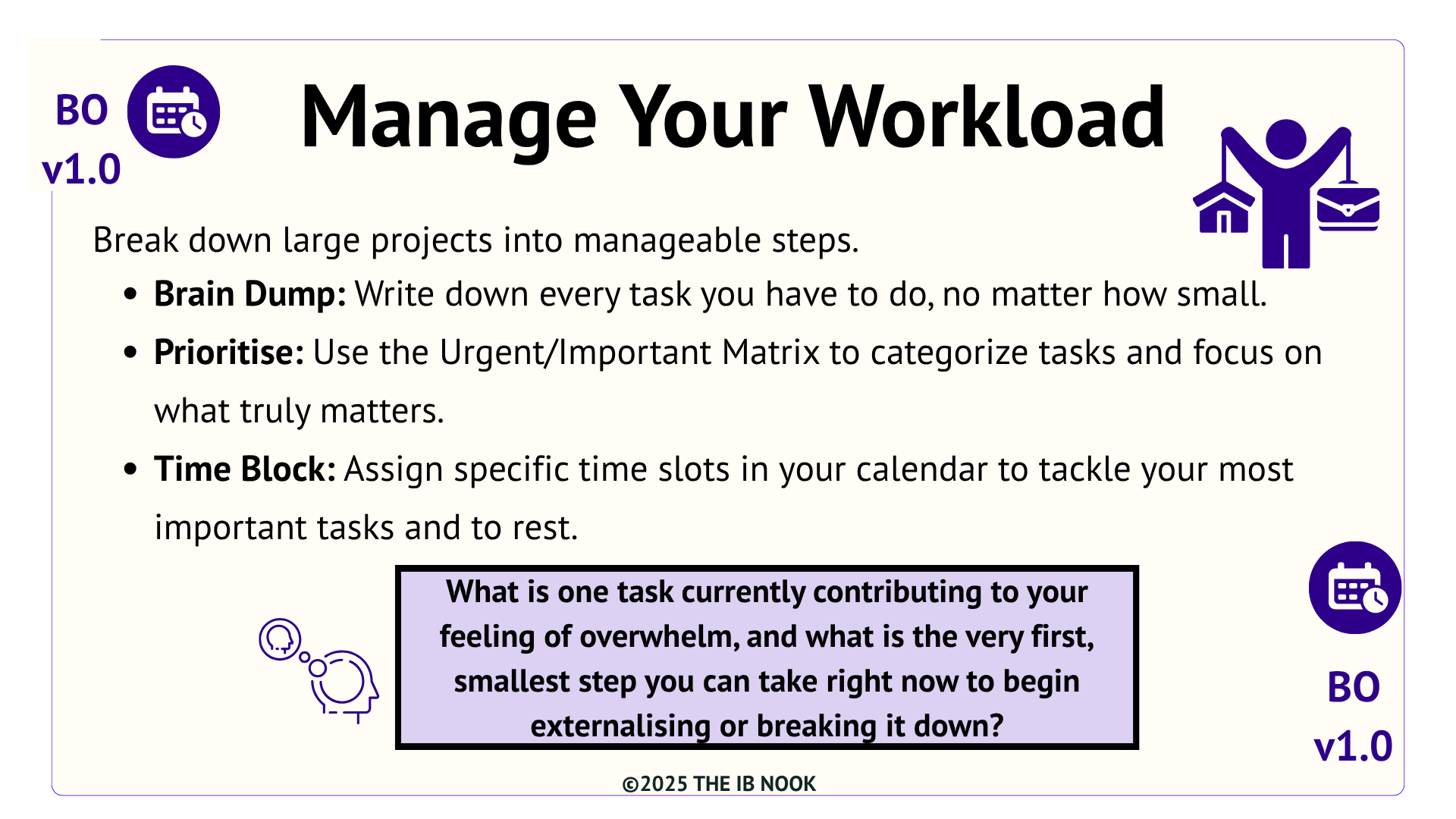
Skill Focus: Strategic Planning & Proactive Time Management
This bonus card introduces a crucial skill for every IB student: managing your workload. The IB Diploma Programme is demanding, and without a clear system for handling deadlines, assignments, and personal commitments, the pressure can feel overwhelming. This lesson will show you how to move from feeling reactive to feeling in control by using proactive planning and smart prioritisation.
The Core Idea (Basis): From Overwhelm to Order
The feeling of being overwhelmed is often a symptom of not having a clear plan. Your brain is trying to keep track of a hundred different tasks, which drains your mental energy and makes it hard to start anything. This leads to procrastination, stress, and missed deadlines.
Managing your workload isn't about working more; it's about working smarter. It’s a skill that requires you to:
Externalise Your Tasks: Get everything out of your head and into a system you can trust.
Prioritise Effectively: Understand which tasks are most important and which can wait.
Break Down Big Goals: Make intimidating projects feel manageable by breaking them into smaller, achievable steps.
Balance Work and Rest: Recognise that rest is a productive part of your schedule, not an afterthought.
This skill is a direct application of RD 07: Plan Your Action and SM 07: Set Smart Goals gives you the practical tools to turn your intentions into reality.
Your Action Plan (Application): 4 Steps to Take Control
Integrate this practice whenever you feel the stress of too much to do.
-
Do a "Brain Dump" to Externalise Your Workload:
Grab a piece of paper or open a digital note.
Write down every single task you have to do, no matter how big or small. This includes everything from "start Extended Essay research" to "reply to Mrs. Smith's email" to "do laundry."
Getting it all out of your head creates instant mental space.
-
Prioritize with the "Urgent/Important" Matrix:
-
Review your list and categorie each task into one of four boxes:
Urgent & Important: Do these tasks now. (e.g., an IA draft due tomorrow).
Important, but Not Urgent: Schedule time to do these. (e.g., Start work on an EE, prepare for a test in two weeks).
Urgent, but Not Important: Delegate or minimize these. (e.g., replying to a non-essential group chat message).
Not Urgent & Not Important: Eliminate these tasks. (e.g., mindless scrolling on social media).
-
-
Break Down Intimidating Tasks:
For the big tasks in your "Important" boxes (e.g., "Write a 1,600-word essay"), turn them into a clear list of smaller steps.
Example: "Write essay" becomes: 1. Create a clear thesis statement. 2. Outline the introduction. 3. Find 3 key sources. 4. Write the first body paragraph.
This makes the task feel less daunting and gives you a clear path forward.
-
Time Block Your Schedule:
Use a calendar to assign specific time slots to the tasks in your "Urgent & Important" and "Important, but Not Urgent" boxes.
Be realistic. Block time for school, extracurriculars, sleep, meals, and social time.
Crucially, block time for rest and breaks. Rest is part of the plan, not a reward for finishing everything.
Manage Your Workload Support Videos
This strategy is about breaking down large assignments into manageable tasks, prioritising them using methods like the Eisenhower Matrix, and creating a structured schedule to tackle them.
This video provides a valuable alternative to standard time management advice. It gives you a deeper understanding of the mental blocks that contribute to procrastination, offering a more holistic and sustainable approach to managing your workload.
Reflect & Grow: Your Personal Check-in
Take a moment to engage with this lesson now:
Right now, which of your tasks would fall into the "Urgent & Important" box? What is one small step you can take on that task within the next 20 minutes?
How might you use a time-blocking approach to build a more sustainable routine?
How can you use this skill to become a more Balanced and Organised learner, helping you manage stress and free up mental energy for creative and critical thinking?